
Progressive tiered pricing
One of the most commonly known ways to configure usage-based pricing.
Tiered pricing, also called progressive tiered pricing, is a pricing structure in which, most of the time, the price of a product or service with the price per unit decreases as the usage increases.
In progressive tiered pricing, each usage tier is incremental, meaning that the customer must "fill up" the current tier before moving on to the next one. So if a customer uses more, they pay less per unit. In some cases, this is the other way around - for example with water usage of households: the last tier is more expensive to discourage more than average usage of water.
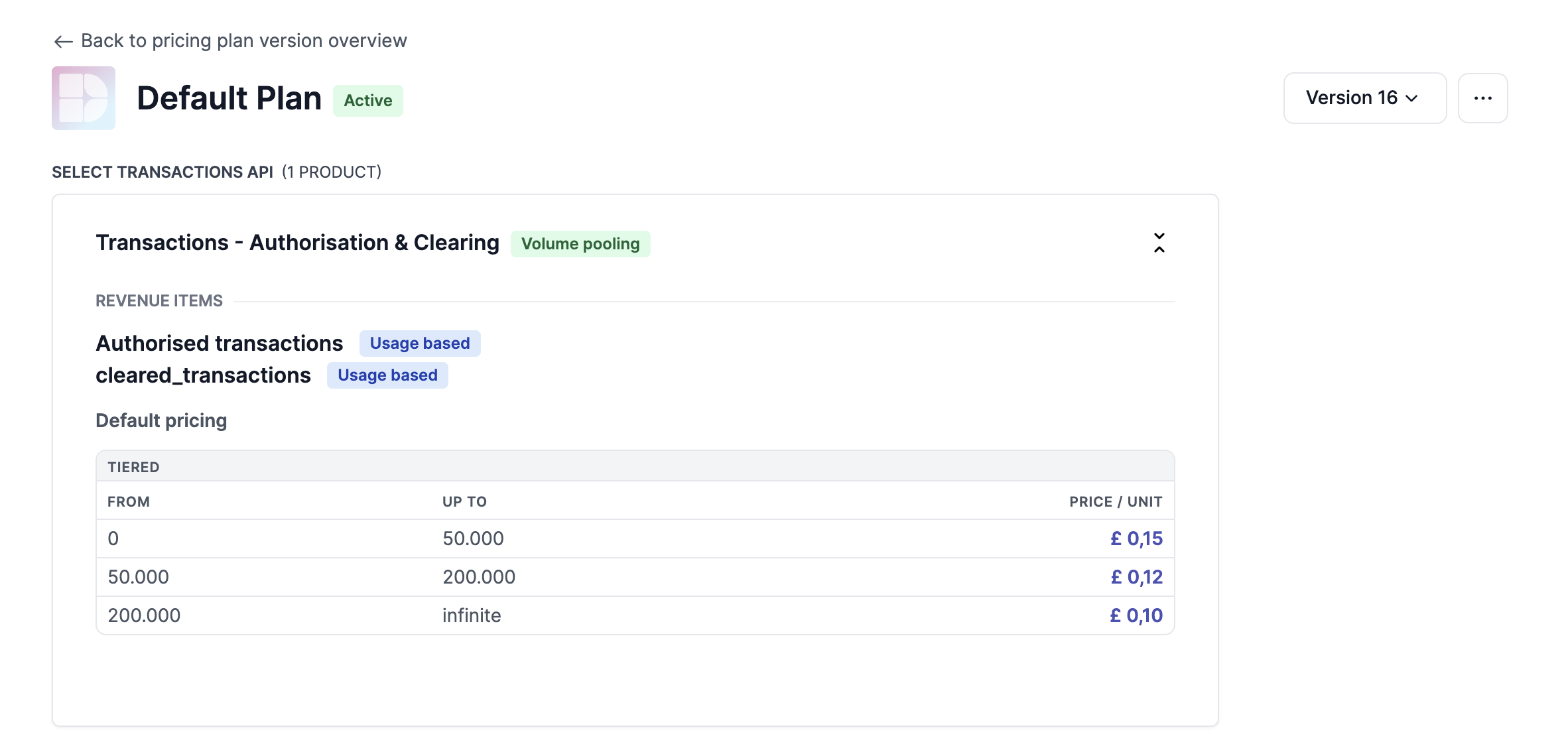
Unit-based example
In the most used type, more usage is encouraged by offering lower prices. For example, if the first tier is for usage up to 100 GB and the second tier is for usage from 100 up to 1000 GB, the customer would pay a higher price for the first 100 GB they used, and a lower price for the next 100 GB.
| Lower bound | Upper bound | Price |
|---|---|---|
| 0 | ≤ 100 | 0.10 EUR |
| > 100 | ≤ 1000 | 0.08 EUR |
| > 1000 | ∞ | 0.07 EUR |
Using this pricing model, if a customer uses 200 GB of storage, they would be charged as follows:
- 0.10 EUR per GB for the first 100 GB = 10.00 EUR
- 0.08 EUR per GB for the next 100 GB = 8.00 EUR
The total cost for 200 GB of usage equals to 18.00 EUR
Percentage-based tiered pricing
Percentage pricing also allows for
An example would be:
| Lower bound | Upper bound | Price |
|---|---|---|
| 0.00 EUR | ≤ 100.00 EUR | 10% |
| > 100.00 EUR | ≤ 1000.00 EUR | 8% |
| > 1000.00 EUR | ∞ | 5% |
If a customer processed a total of €200.00 transactions in their billing period, they would be charged with:
- For the first 100 x 10% = €10
- For the next €100 x 8% = €8
So the total invoice line would amount to €18,-
Updated 10 months ago