
Meter properties
Meter properties are additional pieces of information that provide context to an event. They can be used for a variety of purposes, including:
Product definition
A meter may retrieve events from a single source but contain event data for multiple products. Meter properties can be used to identify these products and assign them to the appropriate product category.
Conditional pricing
Meter properties can be used to define pricing rules and differentiate pricing based on the property. This allows you to create individual invoice lines with different prices based on the specific properties of the event.
Revenue and margin allocation
Even if meter properties are not used to separate pricing, you can use them to split out the revenue and margin by defined properties. This can be helpful for understanding the performance of different products.
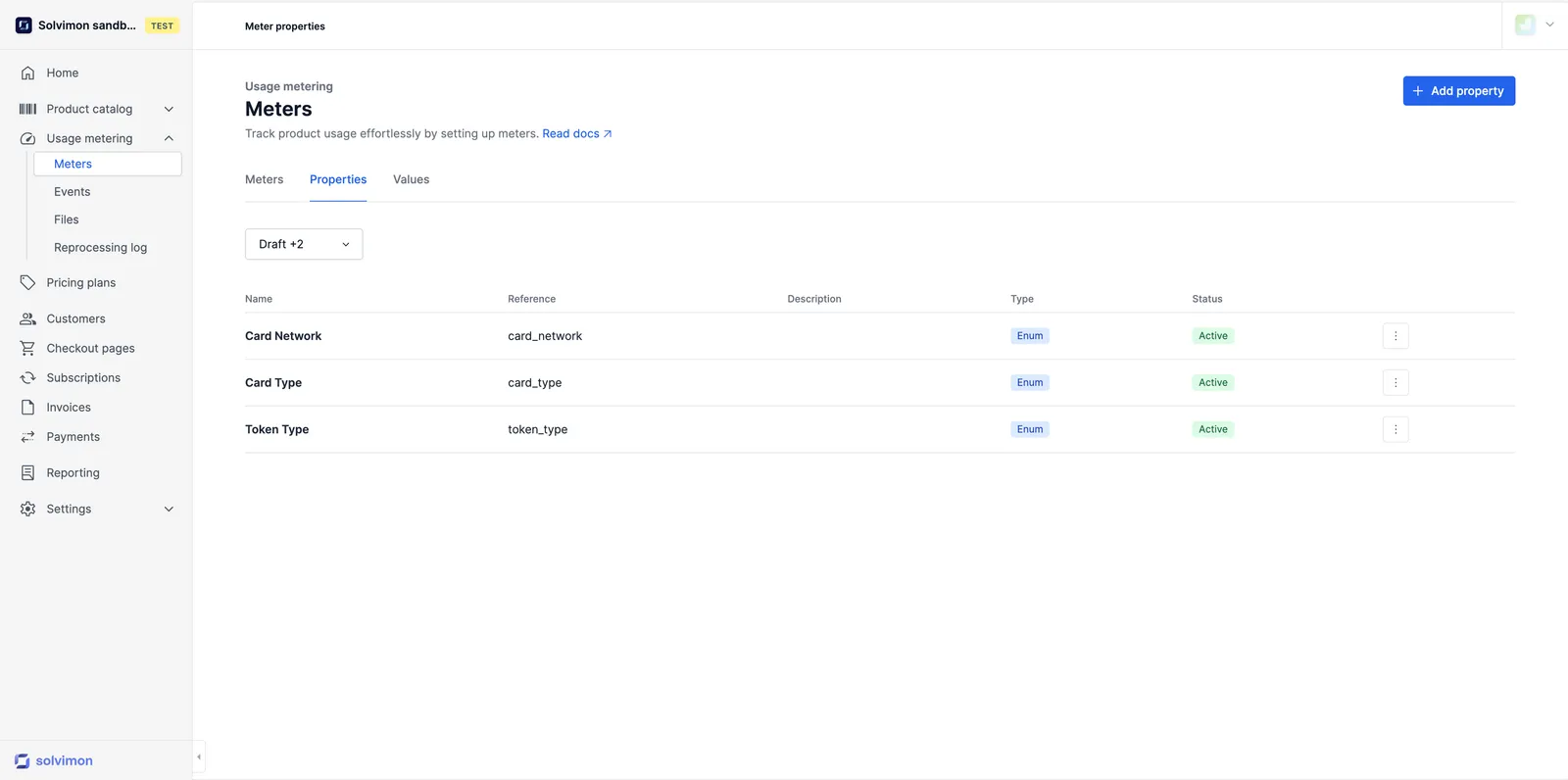
Types of Meter Properties
Meter properties are a useful tool for providing additional context to events and for enabling more sophisticated pricing and revenue management strategies.
Properties can be in the form of:
- A set of predefined values (
ENUM), - Any value (
STRING), - A number (
NUMBER)
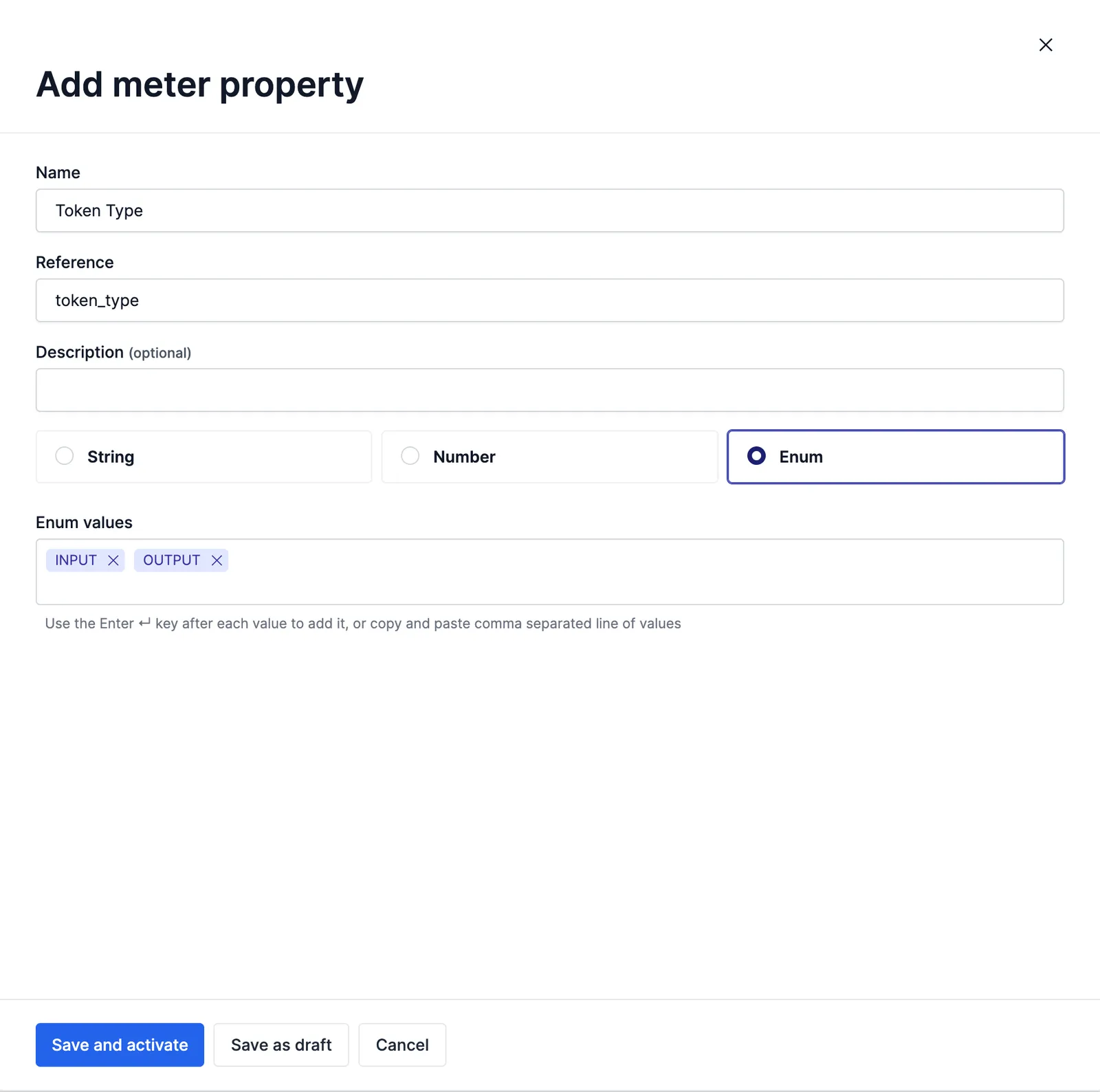
Once a property is active, Solvimon does not allow removing the enum values defined anymore, as they might be linked to usage data. Adding new values is possible.
Filtering on a meter property
A usage-based product item can filter on a meter property, so only the events whose property matches a value are billed by that item. The values you compare against are validated at configuration time against the property’s type.
On a NUMBER property, a value that does not parse as a number is rejected with a values.{index} error naming both the value and the property that refused it. Before this validation the configuration was accepted and then matched nothing during event matching, so the product item sat at zero usage with no indication why. STRING and ENUM properties are unaffected: any string is a legitimate comparison value on a STRING property, and ENUM values are already constrained by the property’s own value list.
Duplicate conditions are rejected too. Two configs on the same pricing item cannot claim the same meter property conditions, and a nested condition group cannot repeat a condition its parent already applies, which prevents a plan where two configs both bill the same usage.
Making a meter property a usage metric
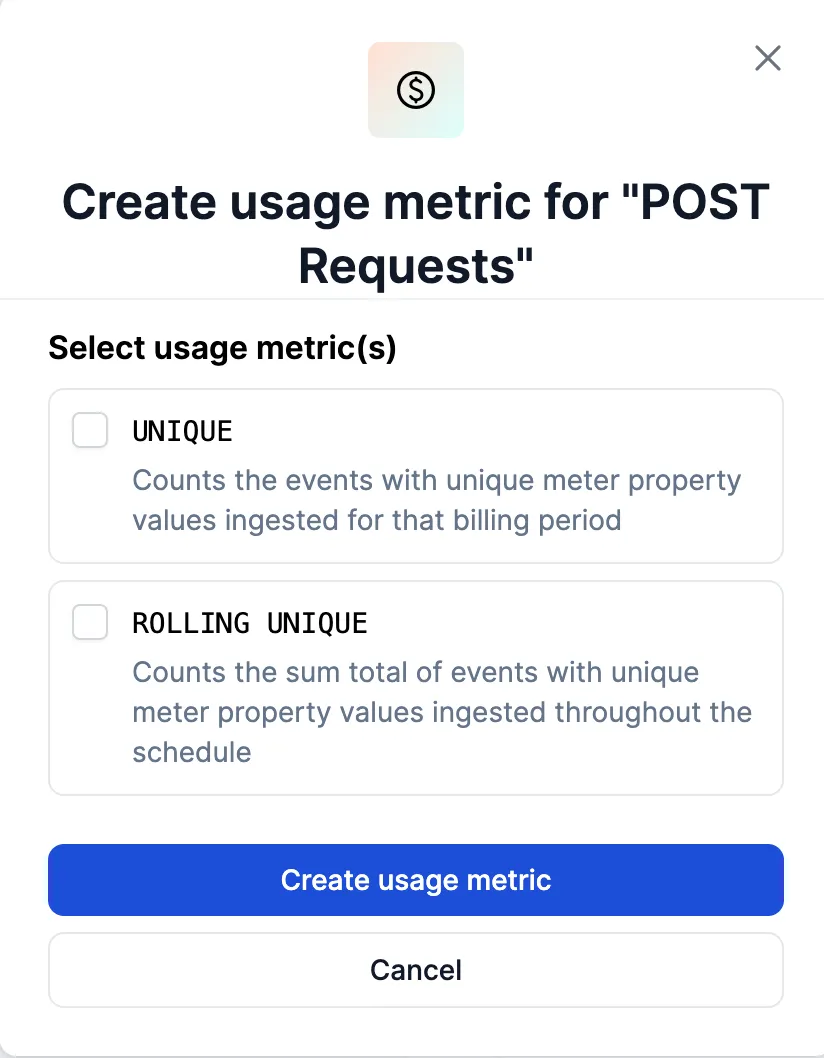
Meter properties only have two types of calculation metrics to make them a usage metric that can be connected to a product:
Uniquei.e. Counts the number of events with unique meter property values that are ingested for the specified billing period of the subscription scheduleRolling Uniquei.e. Counts the sum total of events with unique meter property values that are ingested throughout the schedule for that subscription
Example meter properties
Here are some examples of different properties together with their type and possible values: