
E-invoicing
A growing number of governments are implementing electronic invoicing requirements to make sure businesses prove they are tax compliant. Additionally, electronic invoices can improve efficiency by allowing direct synchronisation between different ERP systems. Electronic versions of an invoice are called e-invoices.
Solvimon offers e-invoicing for a growing number of countries. Are you missing your specific country and need e-invoicing for your billing process? Put in a request with our support team, we continuously add new countries to our offerings.
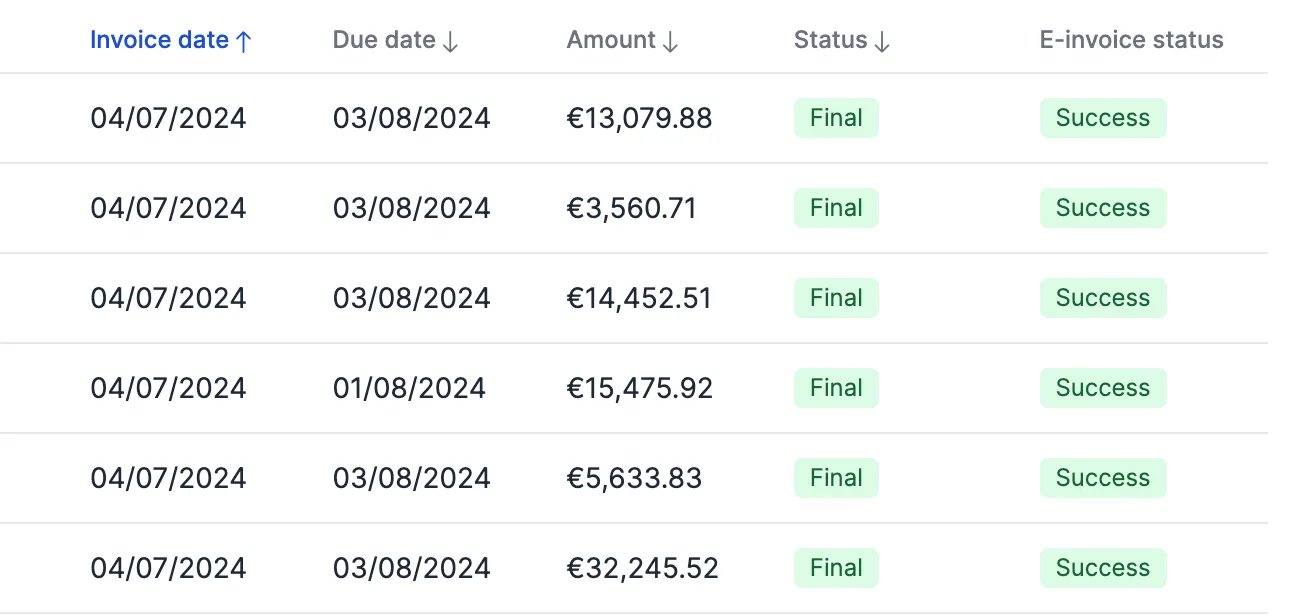 Solvimon offers real-time status updates on e-invoices within the platform
Avalara e-invoicing integration
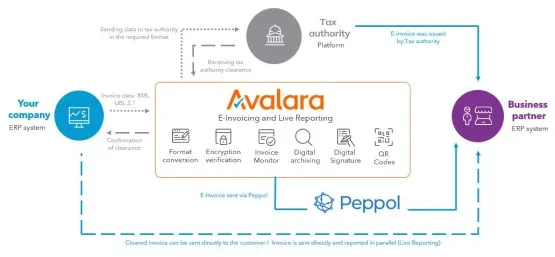
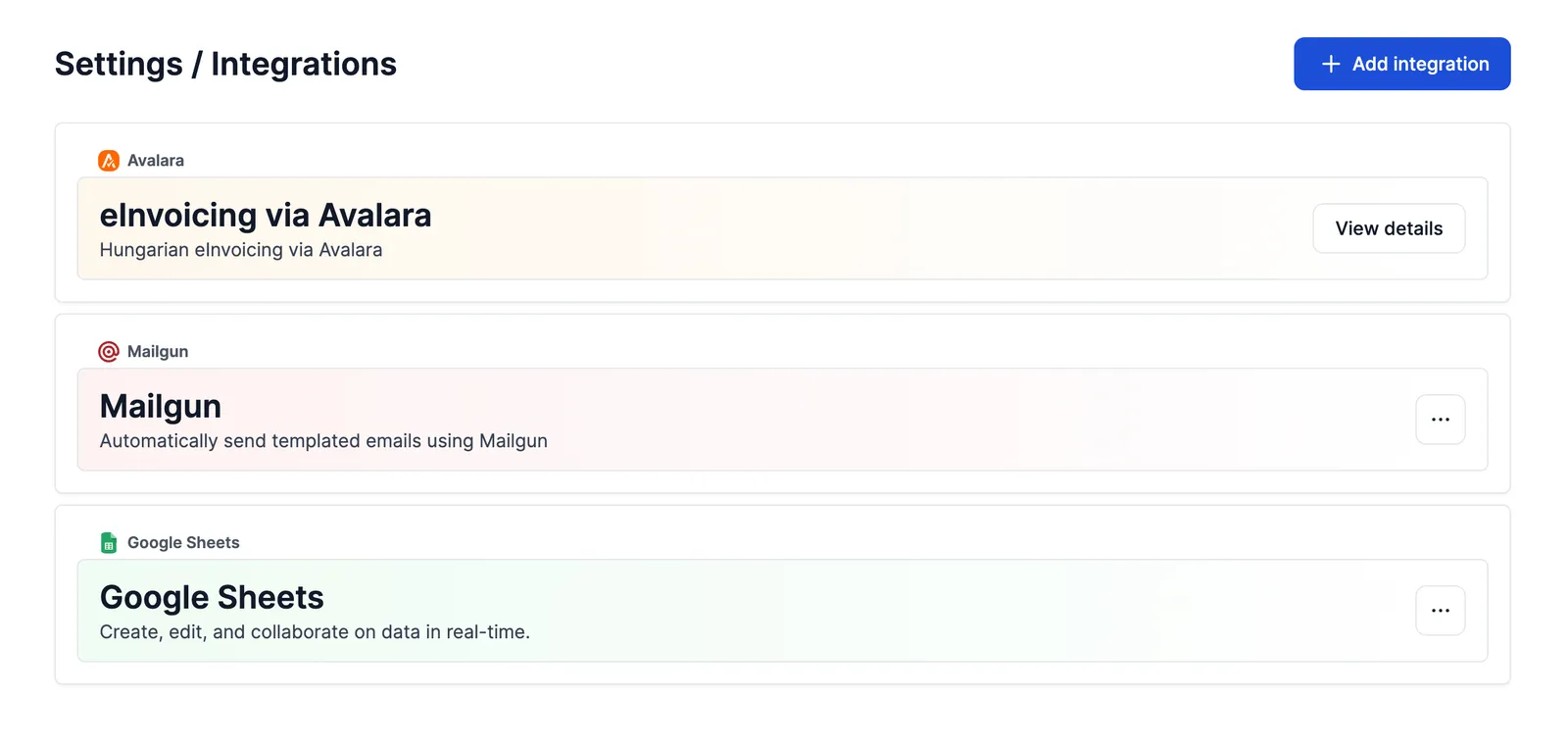
To support many international clients with their e-invoicing requirements, Solvimon offers an out-of-the-box integration with Avalara’s e-invoicing product offering. Solvimon customers need to register with Avalara and check administrative requirements for countries in which they want to use e-invoicing. Our team is happy to support here.
Read more about Avalara and their E-invoicing solutions on their website.
Mandates
E-invoicing works via mandates, which are configurations for specific type of invoices within a certain country. A country can have one or many e-invoicing mandates, such as for B2B or B2C sales, in certain industries or for certain types of products or services.
These configurations depend on the country your billing entity is invoicing from and all have specific requirements. Interested in using our e-invoicing options? Let our team know and we will support setting it up.
Hungary - B2B
The Hungarian NAV government institute requires Hungarian billing entities to send an e-invoice copy of each invoice they send out. Real-Time Information Reporting (RTIR) took effect in Hungary on 1st July 2018 and is now in effect for all B2B and B2C transaction invoices.
Solvimon currently supports the B2B mandate from within the platform.
Estonia
Since July 2025, Estonia has standardised and equalised B2G and B2B e-invoicing requirements through amendments to the Accounting Act. The same regime now applies to all accounting entities.
Legislation
B2G — Electronic invoicing has been mandatory for all Business-to-Government transactions since 1 July 2019. Since July 2025, the new universal regime based on the ‘buyer’s choice’ principle applies to all accounting entities for both B2G and B2B transactions. All accounting entities registered as e-invoice recipients in the commercial register are entitled to receive e-invoices in the European Standard (EN 16931) by default, unless otherwise agreed. Other formats, including the national XML-based standard, remain permitted when both parties agree.
B2B — The same regime applies to all accounting entities for both B2G and B2B transactions.
B2C — There is no business-to-consumer mandate.
Solvimon currently supports the B2G and B2B mandates from within the platform.
Other countries
Please check with us. We can often integrate a new mandate within a month or two.
Managing e-invoices
E-invoice status
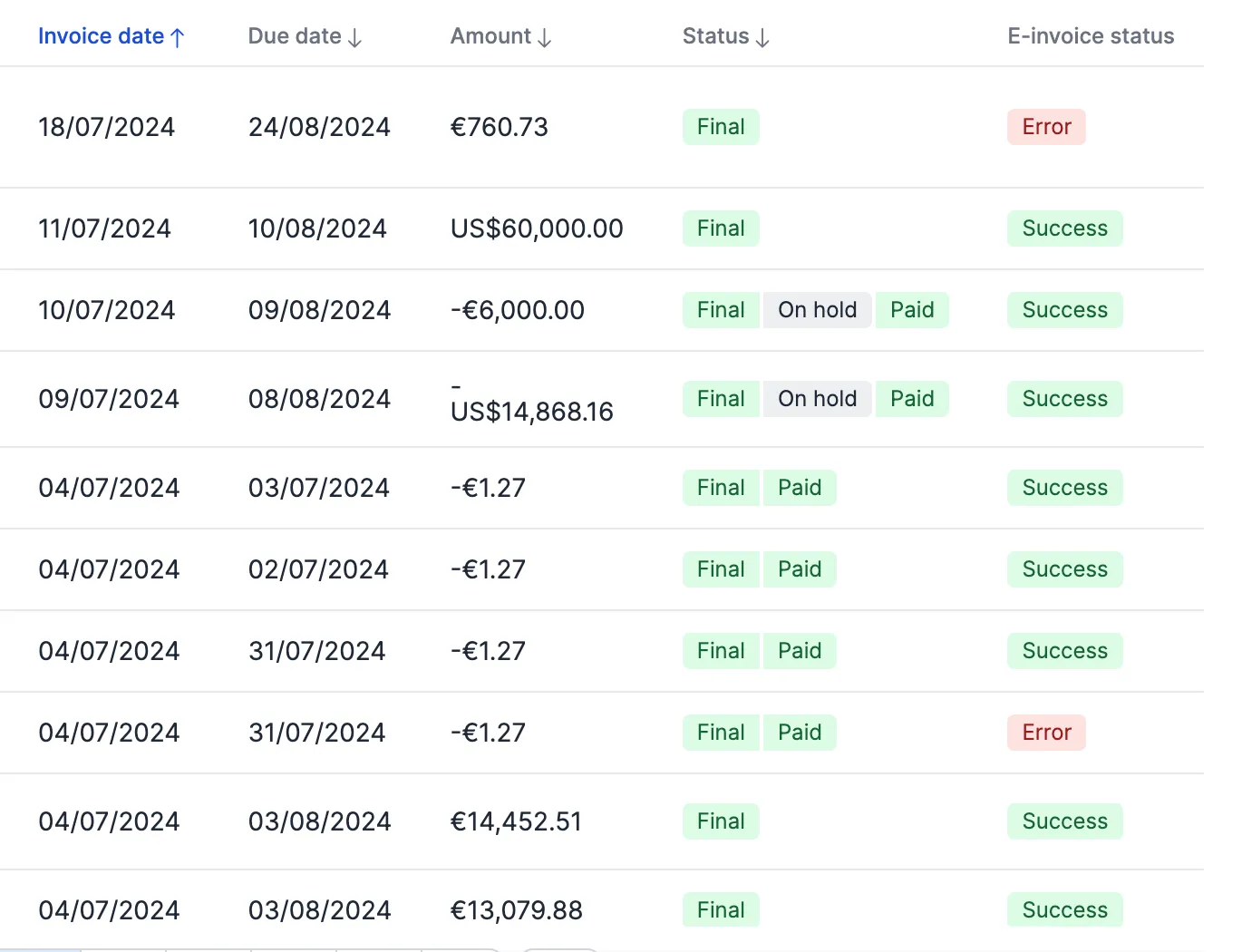
Depending on the mandate, E-invoices are sent once the invoice status is set to Final, or before that happens. Our eInvoicing solution shows whether the e-invoice is being processed, successfully accepted, or threw an error and needs to be fixed.
Most authorities require e-invoices to be correctly submitted within a selected time frame after the issuing of the invoice to the customers, or the invoice date.
Refreshing & Downloading e-invoices
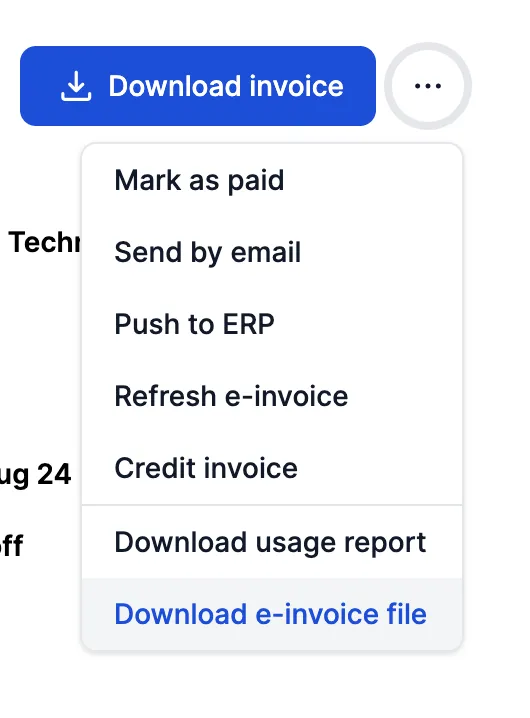
When going to a specific invoice, it is possible to download the latest e-invoice version to check what has been sent to the e-invoicing platform of the billing entity country’s platform.
Solvimon automatically refreshes the status of the e-invoice, but using the ‘Refresh e-invoice’ button does this as well.
If an e-invoice is rejected, for example because the customer’s tax ID is invalid, correct the cause and then resubmit it. In Desk, an e-invoice with an error gets a Resubmit e-invoice option in the invoice’s menu. Through the API, call POST /v1/invoices/{id}/resubmit-e-invoice with the mandate or the external_reference of the e-invoice. Solvimon builds a new e-invoice from the invoice’s current data and submits it. The earlier e-invoice stays on the invoice with its status history.
If you investigated an error and the e-invoice needs no more action, set its status with PATCH /v1/invoices/{id}/update-e-invoice-status. Pass its external_reference, a status of SUBMITTED, ACCEPTED, ERROR, IGNORE or SUCCESS, and an optional message. Solvimon adds the new status to the e-invoice’s status history.
To download an e-invoice through the API, call GET /v1/invoices/{id}/download-e-invoice with its external_reference and a file_format. Use UBL_XML for the document sent to the e-invoicing platform. Use TAX_AUTHORITY_XML or TAX_AUTHORITY_JSON for the document passed on to the tax authority. The e-invoice’s supported_file_formats lists the formats available for it.
Error monitoring
It is possible to implement error monitoring for e-invoices to keep track of any e-invoices that were not accepted by the government instance and need attention or reprocessing.
Whenever an eInvoice has an error, we will show this in the UI as such.
For the same question across a period rather than per invoice, download the e-invoicing report: one line per e-invoice with its mandate, its external reference and the status it last returned.
