For AI agents: a documentation index is available at the root level at /llms.txt and /llms-full.txt. Append /llms.txt to any URL for a page-level index, or .md for the markdown version of any page.
Logo
LoginSandbox
Platform GuidesAPI DocsSDKMCP ServerChangelog
  • Getting started
    • Introduction
    • Concepts
    • Onboarding guide
  • Use cases
    • Monetizing an AI agent
    • Pricing models for AI products
    • Configuring entitlements for AI products
  • Usage metering & events
    • Meters
      • Meter values
      • Meter properties
      • Usage metrics
    • Usage events
    • Unmatched events
    • Event reprocessing
  • Products & plans
    • Product Catalog
    • Pricing Plans
    • Features & Entitlements
  • Wallets & credits
    • Credit types & wallets
    • Credits in pricing plans
  • Customers & subscriptions
    • Customers
    • Subscriptions
    • Quotes
  • Invoicing
    • Invoices
    • Invoice corrections
    • Payment Collections
    • Tax
    • Currencies & Exchange rates
    • E-invoicing
  • Analytics & reporting
    • Insights
    • Report downloads
    • Revenue Recognition & Deferred Revenue
  • Integrations
    • CRM
    • ERP
    • Email Providers
    • Data Imports: Event File Uploads
    • Data Exports
    • Payment Service Providers
  • Settings & admin
    • Billing entities
    • Payment Options
    • User management
    • Customising invoices
    • Custom fields
    • Default platform settings
    • API key creation
    • Alert Rules
    • Workflows
  • Workflows
    • Workflow Triggers
    • Workflow Actions
    • Monitoring and Audit
    • Common Use Cases
  • For developers
    • Introduction
    • Authentication
    • Local development setup
    • API
    • Errors
    • Troubleshooting
    • Query Parameters
    • Expanding Responses
    • Idempotency
    • Timestamp formatting
    • Webhooks
    • Locale
    • MCP Server
LoginSandbox
On this page
  • Number
  • Amount
Usage metering & eventsMeters

Meter values

Was this page helpful?
Previous

Meter properties

Next
Built with

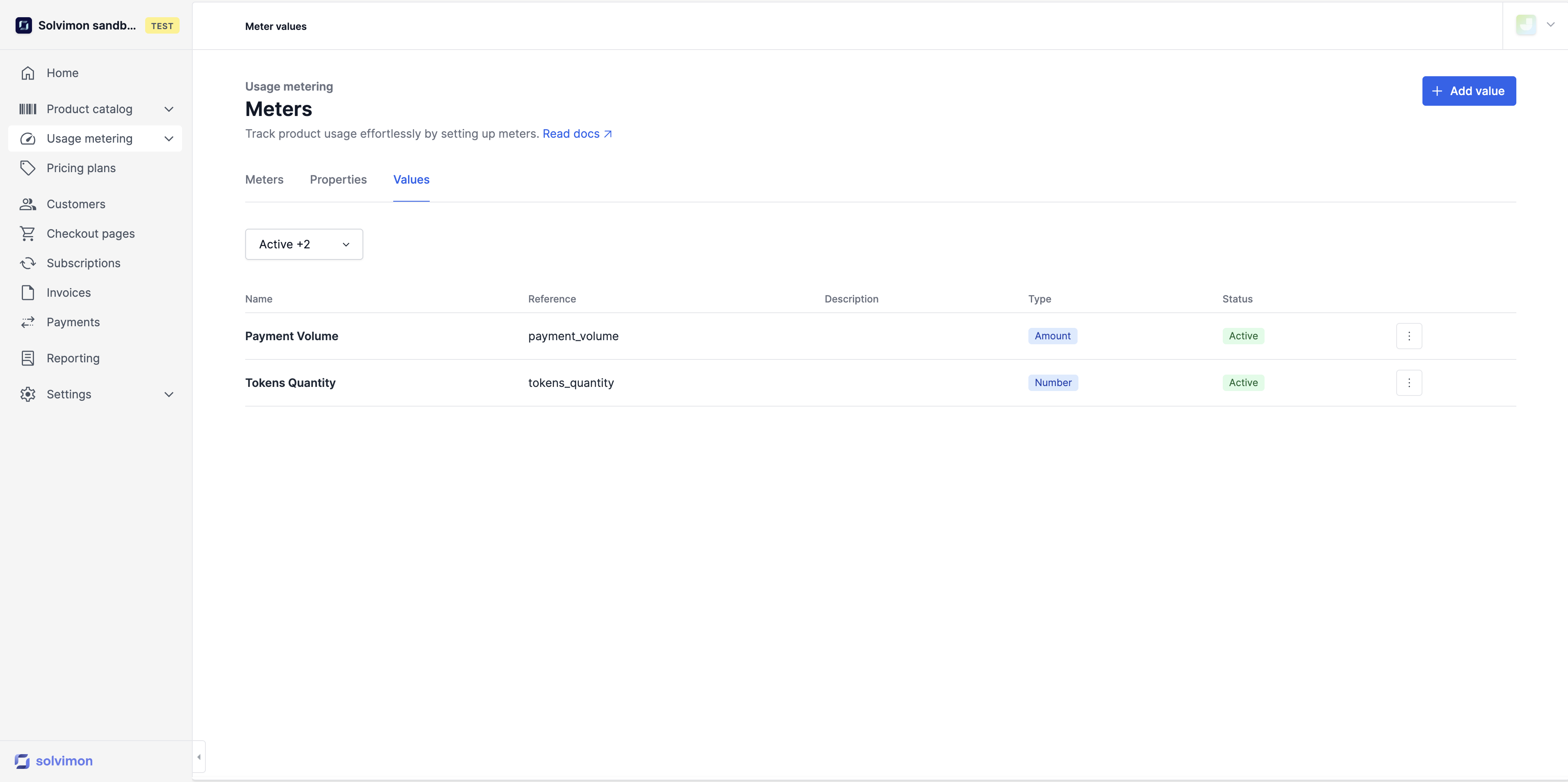
Meter values are the number that denotes the usage of your product by your customers. They are the quantity on the invoice line, when combined with a calculation method to a usage metric.

For example, if you want to charge 0.10 EUR per transaction. The billable unit is the ‘sum of transaction counts’ against which 0.10 EUR is multiplied. Hence, ‘Transactions count’ will be the meter value.

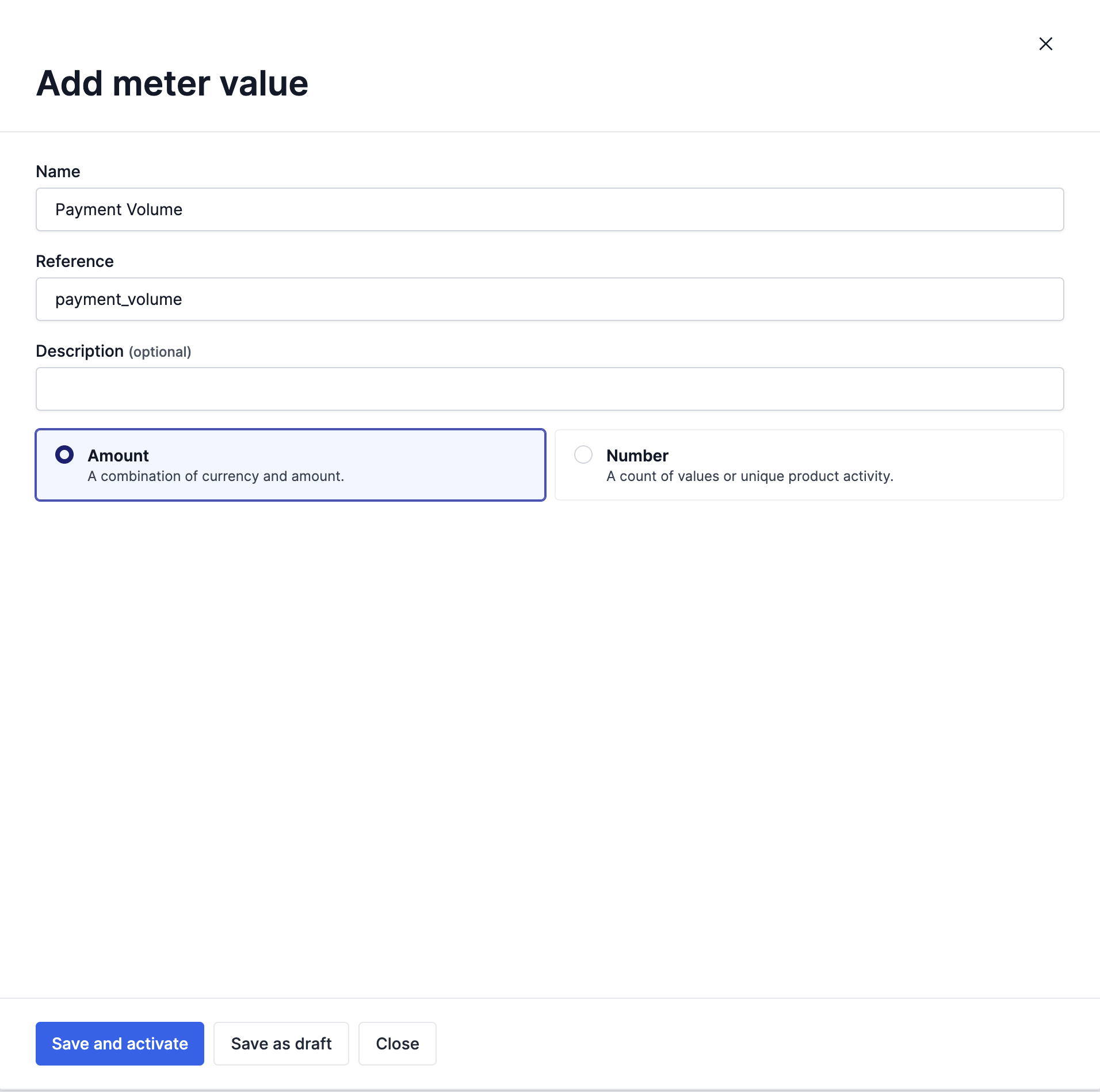
There are two types for meter values:

Number

A number is a count of values or unique product activity occurrences. Examples of number meter values are number of transactions, API calls or shipped packages. The number type of meter values is used for most product usage values.

Amount

A meter value with type amount is a monetary value, most often a transaction of some sort, but not necessarily. They can be bank transfer transaction amounts, package value or insurance value amounts. When usage is ingested for amounts, it is always combined with a currency.

Amount values eventually trigger percentage pricing.